|
Peremennye Zvezdy (Variable Stars) 45, No. 17, 2025 Received 1 December; accepted 11 December. |
Article in PDF |
|
DOI: 10.24412/2221-0474-2025-45-177-184
|
USNO-B1.0 1491-0020709 - A New Double-mode
High-Amplitude  Scuti Star
Sergei V. Antipin1, Alexandra M. Zubareva2,1, Natalia P. Ikonnikova1, Alexandre A. Belinski1, Marina A. Burlak1, Nikolay N. Samus2,1
- Sternberg Astronomical Institute, Lomonosov Moscow
University, Universitetskij pr. 13, 119234 Moscow, Russia
- Institute of Astronomy of the Russian Academy of Sciences, Pyatnitskaya str. 48, 119017 Moscow, Russia
We report a study of USNO-B1.0 1491-0020709, a
high-amplitude Scuti-type star, based on an analysis of
our CCD photometry. The object displays radial pulsations in two
modes simultaneously: first overtone with
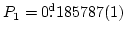 and fundamental mode with
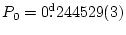 . The period ratio . The period ratio
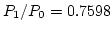 is one of the lowest values in the range
characteristic of double-mode variables of this type. At the same
time, the star turns out to be one of the longest-period
double-mode HADS variables. Its mass estimate, based on the
combination of observational and theoretical Petersen's diagrams,
is in range 1.9-2 is one of the lowest values in the range
characteristic of double-mode variables of this type. At the same
time, the star turns out to be one of the longest-period
double-mode HADS variables. Its mass estimate, based on the
combination of observational and theoretical Petersen's diagrams,
is in range 1.9-2  . .
|
1. Introduction
The classical Scuti variables represent a group of
pulsating stars located in the lower part of the Cepheid
instability strip in the Hertzsprung-Russell diagram, at spectral
types A0-F5. Their brightness changes in the range from 0 003
to 09 in
003
to 09 in  band, with periods from 0
 01 to 0
2
(Samus et al. 2017). At the same time, Breger (2000) reported
different period intervals, from 0
01 to 0
2
(Samus et al. 2017). At the same time, Breger (2000) reported
different period intervals, from 0 02 to 025. Stars with
higher amplitudes (more than 025) are assigned to the subgroup
of high amplitude Sct stars (HADS). Many of them pulsate
at least in two modes: the fundamental mode (
02 to 025. Stars with
higher amplitudes (more than 025) are assigned to the subgroup
of high amplitude Sct stars (HADS). Many of them pulsate
at least in two modes: the fundamental mode ( ) and the first
overtone (
) and the first
overtone ( ). The period ratios
  are found to be in
range 0.76 to 0.78 and depend on masses and metallicities of the
stars (Petersen and Christensen-Dalsgaard 1996; Yang et al. 2021).
The Sct-type stars of solar metallicities have masses
from
are found to be in
range 0.76 to 0.78 and depend on masses and metallicities of the
stars (Petersen and Christensen-Dalsgaard 1996; Yang et al. 2021).
The Sct-type stars of solar metallicities have masses
from
 (short-period stars) to
 (long-period stars) (McNamara 2011).
The variability of USNO-B1.0 1491-0020709 (RA =
00 39
39 19
19 103, Dec = +59
 06
06 37
37
 81 J2000.0; Gaia
Collaboration 2023) was discovered by us in 2013 in the course of
the program of scanning photographic plates of Moscow
stacks1 and
searching for variable stars in the images (e.g. Antipin et al.
2018).
81 J2000.0; Gaia
Collaboration 2023) was discovered by us in 2013 in the course of
the program of scanning photographic plates of Moscow
stacks1 and
searching for variable stars in the images (e.g. Antipin et al.
2018).
We found out that the object belonged to double-mode HADS stars already from photographic photometry, but the accuracy of the photographic photometry was not sufficient to publish its light curve. That was the reason to start more precise CCD photometry.
Independently Chen et al. (2020) also discovered the object as a
variable and designated it ZTF J003919.09+590637.9 while preparing
the catalog of variable stars of the Zwicky Transient Facility
(ZTF) project. The authors classified the star as high-amplitude
Sct object with uncertainty (HADS:) or an eclipsing
system of W UMa type. Their catalog suggests only one period,
01857867.
2. Observations and data reduction
Our photometric observations were carried out in 2014-2023. We
acquired 2897 individual measurements on 107 nights. In 2014 and
2023 one of the authors (A. Z.) collected 1050  frames
with the Zeiss-600 telescope of the Crimean Astronomical Station
of the Sternberg Astronomical Institute of M. V. Lomonosov Moscow
State University. An Apogee AP-47p CCD detector was used in 2014
with exposure times of 180 seconds, and FLI16803 with exposure
times of 120 seconds was used in 2023. In 2020 and 2021, we used
the RC600 telescope of the Caucasus Mountain Observatory of
M. V. Lomonosov Moscow State University (Berdnikov et al. 2020)
equipped with Andor iKon-L (DZ936N-BV) CCD. The images were also
taken in the band, exposure times were 120 seconds.
A. B., M. B., and N. I. acquired 1847 frames. Initial data
reductions included standard operations: the images were corrected
by subtracting biases and dark current, and then divided by flat
field frames. The aperture photometry and the magnitude
calibration were performed by means of
VaST2 software package
(Sokolovsky & Lebedev 2018). Magnitudes of the stars in the field
of view were drawn from the APASS
catalog3. The mean brightness
of USNO-B1.0 1491-0020709 is
frames
with the Zeiss-600 telescope of the Crimean Astronomical Station
of the Sternberg Astronomical Institute of M. V. Lomonosov Moscow
State University. An Apogee AP-47p CCD detector was used in 2014
with exposure times of 180 seconds, and FLI16803 with exposure
times of 120 seconds was used in 2023. In 2020 and 2021, we used
the RC600 telescope of the Caucasus Mountain Observatory of
M. V. Lomonosov Moscow State University (Berdnikov et al. 2020)
equipped with Andor iKon-L (DZ936N-BV) CCD. The images were also
taken in the band, exposure times were 120 seconds.
A. B., M. B., and N. I. acquired 1847 frames. Initial data
reductions included standard operations: the images were corrected
by subtracting biases and dark current, and then divided by flat
field frames. The aperture photometry and the magnitude
calibration were performed by means of
VaST2 software package
(Sokolovsky & Lebedev 2018). Magnitudes of the stars in the field
of view were drawn from the APASS
catalog3. The mean brightness
of USNO-B1.0 1491-0020709 is
 . The typical
errors are close to 0004. The overall light curve is presented
in Fig. 1, and the log of observations is summarized in Table 1.
. The typical
errors are close to 0004. The overall light curve is presented
in Fig. 1, and the log of observations is summarized in Table 1.
3. Periodicities
We used Deeming (1975) method implemented in the WINEFK4 package by Dr. V. P. Goranskij to search for periodicities. The resulting periodogram, where two significant peaks are marked, is given in Fig. 2. The phased light curves for these two periods are presented in Fig. 3a and Fig. 3c. The light elements for the fundamental mode and first overtone are as follows:
HJD
 .
.
.
HJD
 .
.
.
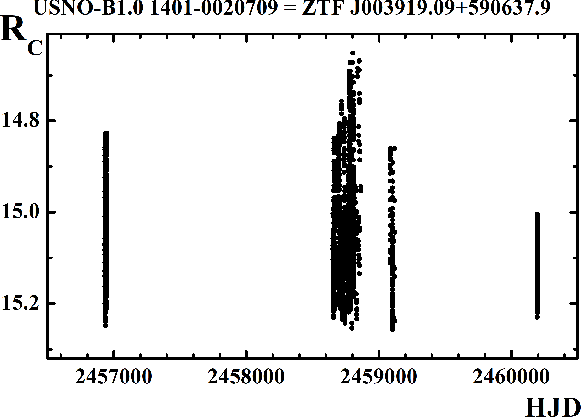
 light curve for
USNO-B1.0 1491-0020709.
light curve for
USNO-B1.0 1491-0020709.
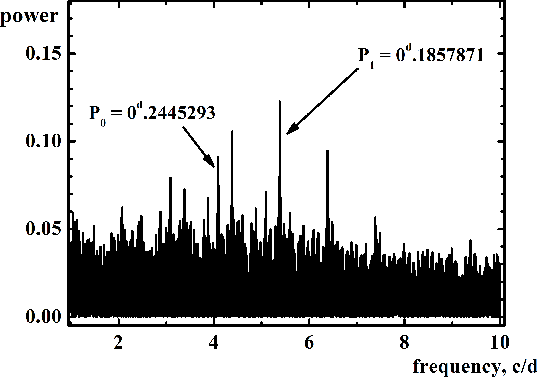 |
Fig. 2. The periodogram for USNO-B1.0 1491-0020709. The arrows indicate the fundamental-mode and the first-overtone frequencies. |
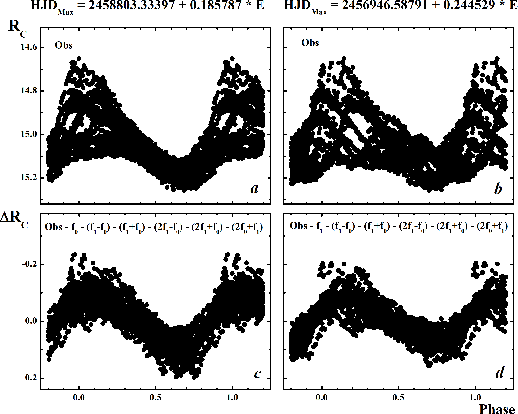 |
Fig. 3. The phased light curves for USNO-B1.0 1491-0020709. The panels are for: (a) first overtone; (b) fundamental mode; (c) first overtone after prewhitening of the fundamental mode and interaction frequencies; (d) fundamental mode after prewhitening of the first overtone and interaction frequencies. |
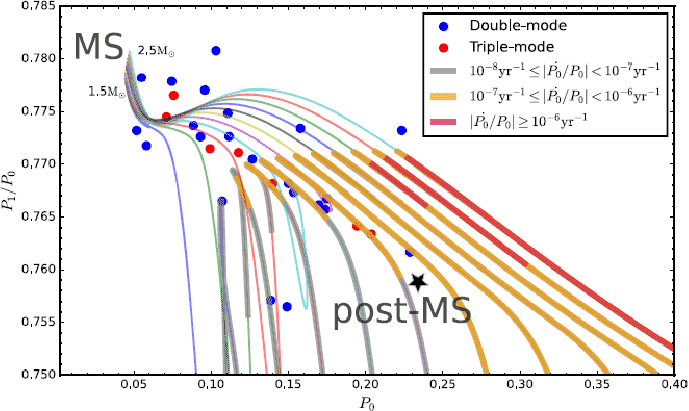 |
Fig. 4. Petersen's diagram for HADS stars pulsating in the fundamental mode and first overtone. The position of USNO-B1.0 1491-0020709 is indicated by a black star. The combination of the Petersen diagram and the evolution tracks is reproduced from Fig. 8 in Xue et al. (2023), see explanation in Section 4. |
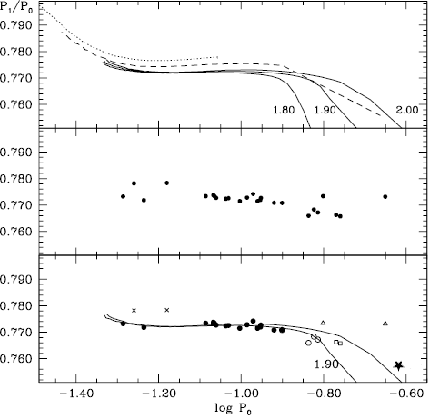 |
Fig. 5. Petersen's diagram for HADS stars pulsating in the fundamental mode and first overtone. The position of USNO-B1.0 1491-0020709 is indicated by a black star. The evolution tracks are a reproduction of Fig. 4 from Poretti et al. (2005), see explanation in Section 4. For detailed explanation of the panels, cf. Poretti et al. (2005). |
We analyzed the power spectra of USNO-B1.0 1491-0020709 to derive possible interaction frequencies and subtract them from our data. Table 2 contains the information about the characteristic values of the signals. The corresponding prewhitened light curves for the first overtone and fundamental mode are presented in Figs. 3b and 3d.
| HJD range | Telescope, CCD | No. of frames |
|
2456932.25 - 2456932.60 |
Zeiss-2, AP-47p | 132 |
| 2456936.24 - 2456936.61 | Zeiss-2, AP-47p | 117 |
| 2456937.27 - 2456937.62 | Zeiss-2, AP-47p | 149 |
| 2456942.27 - 2456942.61 | Zeiss-2, AP-47p | 142 |
| 2456944.34 - 2456944.63 | Zeiss-2, AP-47p | 111 |
| 2456945.32 - 2456945.39 | Zeiss-2, AP-47p | 17 |
| 2456946.24 - 2456946.60 | Zeiss-2, AP-47p | 122 |
| 2458654.38 - 2458654.51 | RC600, iKon-L 936 | 25 |
| 2458657.42 - 2458657.44 | RC600, iKon-L 936 | 4 |
| 2458659.42 - 2458659.51 | RC600, iKon-L 936 | 54 |
| 2458660.37 - 2458660.40 | RC600, iKon-L 936 | 15 |
| 2458661.45 - 2458661.48 | RC600, iKon-L 936 | 14 |
| 2458662.46 - 2458662.51 | RC600, iKon-L 936 | 30 |
| 2458666.43 - 2458666.51 | RC600, iKon-L 936 | 51 |
| 2458667.42 - 2458667.51 | RC600, iKon-L 936 | 42 |
| 2458669.48 - 2458669.52 | RC600, iKon-L 936 | 24 |
| 2458672.43 - 2458672.49 | RC600, iKon-L 936 | 35 |
| 2458675.48 - 2458675.52 | RC600, iKon-L 936 | 20 |
| 2458693.50 - 2458693.51 | RC600, iKon-L 936 | 3 |
| 2458694.45 - 2458694.53 | RC600, iKon-L 936 | 50 |
| 2458696.43 - 2458696.47 | RC600, iKon-L 936 | 20 |
| 2458704.42 - 2458704.53 | RC600, iKon-L 936 | 69 |
| 2458707 - 2458739 (11 nights) | RC600, iKon-L 936 | 310 |
| 2458742 - 2458806 (29 nights) | RC600, iKon-L 936 | 707 |
| 2458807.25 - 2458807.34 | RC600, iKon-L 936 | 60 |
| 2458808.17 - 2458808.20 | RC600, iKon-L 936 | 20 |
| 2458811.36 - 2458811.49 | RC600, iKon-L 936 | 89 |
| 2458812 - 2458863 (23 nights) | RC600, iKon-L 936 | 68 |
| 2459085.50 - 2459085.55 | RC600, iKon-L 936 | 30 |
| 2459097.47 - 2459097.47 | RC600, iKon-L 936 | 1 |
| 2459103.44 - 2459103.57 | RC600, iKon-L 936 | 85 |
| 2459104 - 2459121 (13 nights) | RC600, iKon-L 936 | 21 |
| 2460195.49 - 2460195.59 | Zeiss-2, FLI16803 | 65 |
| 2460196.45 - 2460196.60 | Zeiss-2, FLI16803 | 105 |
| 2460197.47 - 2460197.60 | Zeiss-2, FLI16803 | 90 |
In total: 107 nights |
2897 | |
We found that USNO-B1.0 1491-0020709 exhibited the lowest period
ratio for double-mode HADS stars: = 0.7598, which is
slightly below the typical interval for , which is
0.76-0.78 (Petersen & Christensen-Dalsgaard 1996; Yang et al.
2021). The statistics of double-mode HADS stars (e.g. their
distribution by periods) is quite incomplete. As of the end of
2025, it is very difficult to take into account all relevant
publications with sufficient numbers of double-mode HADS stars.
From several publicly available surveys, especially the TESS
mission, more than 2400 double-mode (or even multimode) HADS stars
are known. In some cases, authors do not subdivide their HADS
stars into single-mode, two-mode, or three-mode pulsator groups,
making it difficult to quickly locate needed objects in their
lists. Yang et al. (2021) released a catalog containing 144
double-mode HADS stars pulsating in the fundamental mode and the
first overtone. The catalog is a compilation of previously
published pulsating stars from papers of different researchers.
Khruslov (2021, 2022, 2023, 2024) released four catalogs of
double- and multi-mode pulsating variables containing almost 250
HADS stars. Less than twenty HADS stars in these catalogs have
fundamental-mode periods exceeding 0.2 days. Jia et al. (2024)
reported more than 2100 newly discovered double-mode HADS stars
from the ZTF data archive. Xue et al. (2023) published a study of
27 double-mode HADS variables found in the TESS mission data.
| Frequency, c/d | Period, d | Amplitude, mag | |
|
|
5.382508 | 0.1857871 | 0.260 |
 |
4.089490 | 0.2445293 | 0.175 |
 |
1.293018 | 0.7733843 | 0.088 |
 |
9.472002 | 0.1055743 | 0.058 |
 |
6.675567 | 0.1498000 | 0.033 |
 |
14.854527 | 0.0673200 | 0.021 |
 |
13.562025 | 0.0737353 | 0.012 |

4. Mass determination using the Petersen's diagram
Masses of double-mode pulsating variable stars can be estimated
with no information about their luminosities and effective
temperatures. The two independent periods derived from
observations are sufficient for this purpose. The ratio of the
star's period in the first overtone and that in the fundamental
mode (or, simpler, of the shorter period to the longer one) should
be in a narrow interval that depends on the mass of the variable.
Petersen (1973) was the first to apply this idea to double-mode
Cepheids by comparing theoretical computations to observational
data. Later Petersen & Christensen-Dalsgaard (1996) demonstrated
applicability of the approach to high-amplitude Scuti
stars. The typical values for are 0.76-0.78.
Based on Petersen's diagram for HADS stars from TESS published by
Xue et al. (2023), we can give a quite precise estimate for the
mass of USNO-B1.0 1491-0020709. We reproduce the upper panel of
Fig. 8 from Xue et al. (2023) and place there our object, marked
with a star. Knowing the period ratio for USNO-B1.0 1491-0020709
from our CCD observations, we plot the object in the diagram in
accordance with its periods corresponding to =0.7598 and
 . The resulting mass estimate is in range 1.9-2
(see Fig. 4). Note that the evolutionary tracks in Fig. 8
from Xue et al. (2023) were computed for a certain fixed
metallicity (see the discussion therein). If we try to place
USNO-B1.0 1491-0020709 with
. The resulting mass estimate is in range 1.9-2
(see Fig. 4). Note that the evolutionary tracks in Fig. 8
from Xue et al. (2023) were computed for a certain fixed
metallicity (see the discussion therein). If we try to place
USNO-B1.0 1491-0020709 with
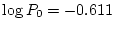 and
=0.7598 in Petersen's diagram combined with evolutionary
tracks published in Fig. 4 from Poretti et al. (2005), we get a
mass estimate slightly exceeding 2 (Fig. 5). Poretti et
al. (2005) used a different approach to constructing evolutionary
tracks and considered effects of metallicity changes.
Determinations of HADS masses with high accuracy by means of
Petersen's diagrams from theory and observations are not
straightforward. The estimates are good for quite massive
double-mode (or multi-mode) puslators, as in the case of
USNO-B1.0 1491-0020709. But for double-mode HADS stars with
and
=0.7598 in Petersen's diagram combined with evolutionary
tracks published in Fig. 4 from Poretti et al. (2005), we get a
mass estimate slightly exceeding 2 (Fig. 5). Poretti et
al. (2005) used a different approach to constructing evolutionary
tracks and considered effects of metallicity changes.
Determinations of HADS masses with high accuracy by means of
Petersen's diagrams from theory and observations are not
straightforward. The estimates are good for quite massive
double-mode (or multi-mode) puslators, as in the case of
USNO-B1.0 1491-0020709. But for double-mode HADS stars with
 (
(
 ), the theoretical Petersen's
diagrams almost coincide with each other no matter the mass of the
star given the same metallicity (for example, see Poretti et al.
2005 and Xue et al. 2023).
), the theoretical Petersen's
diagrams almost coincide with each other no matter the mass of the
star given the same metallicity (for example, see Poretti et al.
2005 and Xue et al. 2023).
5. Conclusions
We performed observations and analysis of photometric data for a
high-amplitude Scuti type star USNO-B1.0 1491-0020709 in
the time interval between 2014 and 2023. We analyzed our data for
periodicities with the help of WINEFK package and found two
periods,
and
. Using
Petersen's diagram that relates periods, period ratios, and masses
for double-mode pulsators including HADS variables, we estimated
the mass of USNO-B1.0 1491-0020709 as
 .
Among many hundreds of currently known double-mode HADS stars
(Khruslov 2021, 2022, 2023, 2024; Yang et al. 2021; Xue et al.
2023; Jia et al. 2024), only several per cent of objects have
fundamental periods close to 0
25, which corresponds
to masses
.
Among many hundreds of currently known double-mode HADS stars
(Khruslov 2021, 2022, 2023, 2024; Yang et al. 2021; Xue et al.
2023; Jia et al. 2024), only several per cent of objects have
fundamental periods close to 0
25, which corresponds
to masses
 . High-accuracy mass estimation for
double-mode HADS stars using the observational and theoretical
Petersen's diagrams is quite possible for massive pulsators.
. High-accuracy mass estimation for
double-mode HADS stars using the observational and theoretical
Petersen's diagrams is quite possible for massive pulsators.
Acknowledgments. The authors are grateful to Dr. K. V. Sokolovsky for his VaST software package and enormous multi-skilled efforts which made the study of objects in scanned images from Moscow Plate Archive feasible.
The study was conducted under the state assignments of Lomonosov Moscow State University and of the Institute of Astronomy (Russian Academy of Sciences). The work was supported in part by M. V. Lomonosov Moscow State University Program of Development.
References:
Antipin, S. V., Becker, I., Belinski, A. A., et al. 2018, Res. Astron. & Astrophys., 18, No. 8, 92
Berdnikov, L. N., Belinskii, A. A., Shatskii, N. I., et al. 2020, Astron. Rep., 64, No. 4, 310
Breger, M. 2000, Delta Scuti and Related Stars, Reference Handbook and Proceedings of the 6th Vienna Workshop in Astrophysics, M. Breger & M. Montgomery (eds.), ASP Conf. Ser., 210, 3
Chen, X., Wang, S., Deng, L., et al. 2020, Astrophys. J. Suppl. Ser., 249, id. 18
Deeming, T. J. 1975, Astrophys. & Space Sci., 36, No. 1, 137
Gaia Collaboration, Vallenari, A., Brown, A. G. A., et al. 2023, Astron. & Astrophys., 674, A1
Jia Q., Chen, X., Wang, S., et al. 2024, Astrophys. J. Suppl. Ser., 273, id. 17
Khruslov, A. V. 2021, Perem. Zvezdy, 41, No. 8, 59
Khruslov, A. V. 2022, Perem. Zvezdy, 42, No. 5, 28
Khruslov, A. V. 2023, Perem. Zvezdy, 43, No. 7, 55
Khruslov, A. V. 2024, Perem. Zvezdy, 44, No. 6, 56
McNamara, D. H. 2011, Astron. J., 142, No. 4, id. 110
Petersen, J. O. 1973, Astron. & Astrophys., 27, No. 1, 89
Petersen, J. O., Christensen-Dalsgaard, J. 1996, Astron. & Astrophys., 312, No. 2, 463
Poretti, E., Suáres, J. C., Niarchos, P. G., et al. 2005, Astron. & Astrophys., 440, No. 3, 1097
Samus, N. N., Kazarovets E. V., Durlevich O. V., Kireeva N. N., Pastukhova E. N. 2017, Astron. Rep., 61, No. 1, 80
Sokolovsky, K. V., Lebedev, A. A. 2018, Astron. and Computing, 22, 28
Xue, W., Niu, J.-S., Xue, H.-F., et al. 2023, Res. in Astron. & Astrophys., 23, No. 7, id. 075002
Yang, T.-Z., Zuo, Z.-Y., Wang, X., et al. 2021, arXiv e-print 2110.13594v1